
AI Appointment Setter: 7 Best Tools for 2026
Artificial Intelligence AI Appointment Scheduling, AI Appointment Setter, AI Automation, AI Booking Software, AI Receptionist, AI Scheduling Assistant, Best AI Appointment SetterMissing customer calls, delayed responses, and endless scheduling emails can cost businesses valuable opportunities. An AI appointment setter helps solve these problems by answering inquiries, qualifying leads, and scheduling meetings automatically.
In 2026, AI appointment setting software has become more sophisticated. Modern tools can communicate through phone calls, text messages, and other channels, helping businesses manage bookings without relying entirely on manual scheduling.
However, choosing the right solution requires more than comparing features. Businesses must consider appointment accuracy, calendar integrations, customer experience, security, and ongoing costs.
This guide explores seven AI appointment setter tools, explains how they work, and helps you select the most suitable option for your business.
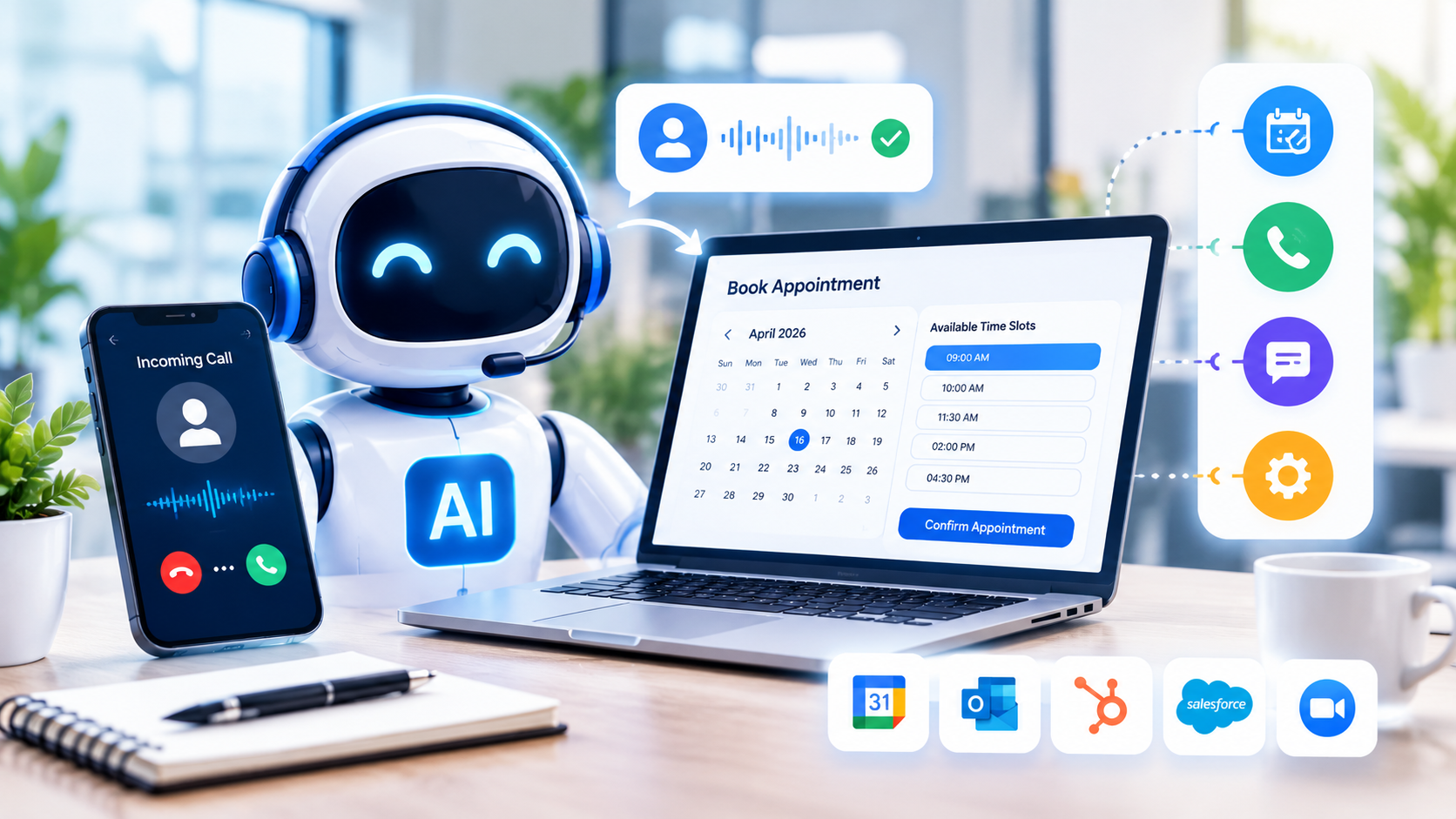
What Is an AI Appointment Setter?
An AI appointment setter is software that uses artificial intelligence to communicate with potential customers and help schedule appointments.
Unlike basic scheduling applications that simply display available time slots, an AI appointment setter can participate in conversations, understand customer requirements, and guide people through the booking process.
Depending on the platform, it may:
- Answer incoming customer calls.
- Contact leads after they submit inquiries.
- Ask questions to qualify potential customers.
- Check connected calendars for availability.
- Schedule, confirm, or reschedule appointments.
- Send reminders and update customer records.
For example, a dental clinic could use an AI scheduling assistant to answer routine booking calls after business hours and offer available appointment times.
Businesses exploring more advanced automation can also learn about AI agent development through our guide to AI Agent Platforms.
7 Best AI Appointment Setter Tools in 2026
The following tools address different appointment-setting requirements, from small-business reception to advanced voice automation.
1. Goodcall — Best for Small Businesses
Goodcall provides AI-powered phone agents designed to help businesses answer calls and manage customer inquiries.
Its conversational AI capabilities make it relevant for service providers that receive frequent appointment requests.
Key Features:
- AI-powered phone answering
- Customer inquiry handling
- Appointment-related workflows
- Business information responses
- Call routing and integrations
Pros:
- Designed for small-business use cases.
- Helps manage calls outside normal business hours.
- Reduces dependence on manual call answering.
Cons:
- Complex scheduling workflows may require additional configuration.
- Businesses should verify integration compatibility before subscribing.
Best For: Local service businesses, salons, and appointment-based companies.
Pricing: Subscription-based plans; check the official website for current rates.
2. Smith.ai — Best for AI and Human Reception Support
Smith.ai combines AI receptionist capabilities with access to human support.
This approach is useful when businesses need automation but also want complicated customer conversations handled by people.
Key Features:
- AI receptionist services
- Call answering and lead intake
- Appointment scheduling support
- Human receptionist escalation
- Business integrations
Pros:
- Combines automation with human assistance.
- Suitable for professional service businesses.
- Helps capture inquiries that might otherwise go unanswered.
Cons:
- Human assistance can increase operating costs.
- Pricing depends on service requirements and call volume.
Best For: Law firms, professional services, and businesses handling complex inquiries.
Pricing: Plan and usage dependent.
3. Retell AI — Best for Custom Voice Appointment Agents
Retell AI provides infrastructure for creating conversational voice AI agents.
Businesses and developers can build customized phone agents that interact with customers and connect to external applications.
Key Features:
- Conversational voice AI
- Custom call workflows
- API integrations
- Call monitoring and testing
- Support for inbound and outbound use cases
Pros:
- Flexible customization.
- Suitable for advanced voice workflows.
- Can integrate with existing business systems.
Cons:
- Calendar booking requires appropriate workflow integration.
- Development and maintenance may require technical expertise.
Best For: Developers, agencies, and businesses requiring custom AI voice agents.
Pricing: Usage-based options; review model, voice, and telephony costs.
4. Synthflow — Best for No-Code Voice Automation
Synthflow offers tools for building voice AI agents without developing every component from scratch.
Businesses can design conversational workflows for answering calls, collecting information, and supporting appointment scheduling.
Key Features:
- Visual voice agent builder
- Automated call workflows
- Business application integrations
- Conversational customization
- Call analytics
Pros:
- Visual development environment.
- Supports customized business conversations.
- Suitable for organizations building repeatable voice workflows.
Cons:
- Advanced deployments can involve significant costs.
- Setup, testing, and integration planning are still necessary.
Best For: Agencies and organizations developing customized voice automation.
Pricing: Contact the provider for current plan and enterprise pricing.
5. Thoughtly — Best for Lead Qualification and Booking
Thoughtly focuses on conversational AI agents that can assist with business calls and customer interactions.
Its appointment-setting applications are particularly relevant to companies that want to qualify inquiries before booking meetings.
Key Features:
- AI voice conversations
- Lead qualification workflows
- Appointment booking integrations
- Automated customer follow-up
- Business process customization
Pros:
- Useful for structured qualification processes.
- Can support booking and follow-up workflows.
- Relevant to sales and service teams.
Cons:
- Complex qualification rules require careful testing.
- Integration and deployment requirements vary.
Best For: Sales teams, service providers, and lead-generation businesses.
Pricing: Check official plans or request a quote.
6. Bland AI — Best for Developer-Controlled Phone Automation
Bland AI provides programmable voice AI technology for businesses developing automated phone conversations.
It is particularly relevant when companies need custom outbound calling or specialized call-handling workflows.
Key Features:
- Programmable AI phone calls
- API-based automation
- Custom conversation logic
- Workflow integrations
- Scalable voice applications
Pros:
- Flexible developer-oriented capabilities.
- Useful for customized outbound workflows.
- Supports specialized business applications.
Cons:
- Not a ready-to-use appointment booking system for every business.
- Calendar and CRM integrations may need development.
Best For: Technical teams and businesses building customized calling systems.
Pricing: Usage and plan dependent.
7. Rosie — Best for AI Reception and Call Handling
Rosie provides an AI answering service for small businesses.
It helps organizations manage incoming calls, collect customer information, and support appointment-related requests.
Key Features:
- AI call answering
- Customer message collection
- Business information responses
- Scheduling-related features on eligible plans
- Call summaries and notifications
Pros:
- Focused on small-business phone communication.
- Helps reduce missed calls.
- Can support businesses with limited reception staff.
Cons:
- Direct appointment booking may depend on the selected plan.
- Advanced customization may be limited compared with developer platforms.
Best For: Small service businesses seeking an AI receptionist.
Pricing: Tiered subscription plans; verify booking features before choosing a tier.
AI Appointment Setter Comparison Table
| Tool | Best For | Main Strength |
|---|---|---|
| Goodcall | Small businesses | AI phone reception |
| Smith.ai | Professional services | AI and human support |
| Retell AI | Developers | Custom voice agents |
| Synthflow | Agencies and enterprises | Visual voice automation |
| Thoughtly | Sales teams | Lead qualification |
| Bland AI | Technical teams | Programmable phone calls |
| Rosie | Local businesses | AI call answering |
Quick recommendation: Goodcall and Rosie are worth evaluating for smaller businesses. Smith.ai is relevant when human assistance matters, while Retell AI and Bland AI are better suited to organizations seeking developer-level control.
How Does an AI Appointment Setter Work?
An AI appointment setter typically follows a structured workflow.
Step 1: Receive a Customer Inquiry
A potential customer contacts the business through a supported communication channel, such as a phone call or website inquiry.
Step 2: Understand the Request
The AI system identifies the customer’s intent using speech recognition, language models, and configured conversation instructions.
Step 3: Qualify the Customer
The agent may ask relevant questions about the requested service, location, preferred appointment time, or other requirements.
Step 4: Check Availability
When connected to a calendar or scheduling system, the agent can retrieve available time slots.
Step 5: Confirm the Booking
The agent creates an appointment through an authorized integration and may send confirmation details.
Step 6: Update Business Records
Depending on the software configuration, the system can update customer information, notify employees, or trigger follow-up workflows.
This process can reduce administrative work while maintaining a consistent booking experience.
Benefits of Using AI Appointment Setting Software
24/7 Customer Availability
An AI appointment setter can respond to supported inquiries outside normal office hours, helping businesses capture opportunities when employees are unavailable.
Faster Lead Response
Automated responses can reduce delays between a customer’s initial inquiry and the next step in the booking process.
Reduced Administrative Work
Employees can spend less time handling routine scheduling requests and more time supporting customers with complex needs.
Consistent Lead Qualification
AI agents can follow predefined qualification questions, helping businesses collect relevant information before appointments.
Improved Scheduling Efficiency
Calendar integrations can reduce unnecessary back-and-forth communication and help keep appointment records organized.
However, actual benefits depend on software quality, integration reliability, and customer preferences.
How to Choose the Best AI Appointment Setter
Before investing in AI appointment scheduling software, evaluate the following factors.
1. Calendar Integration
Check whether the platform supports your existing calendar and scheduling software.
Confirm that it can create appointments, prevent double bookings, and handle time zones correctly.
2. Conversation Quality
Test how the AI responds to unclear questions, interruptions, unusual requests, and different speaking styles.
3. CRM Compatibility
Businesses using customer relationship management software should verify whether the platform can update contact records and appointment information.
4. Security and Privacy
Appointment-setting systems may process names, contact details, and other customer information.
Use appropriate access controls, review data retention policies, and follow established cybersecurity best practices.
5. Transparent Pricing
Compare subscription fees, call usage, implementation expenses, integrations, and potential overage charges.
A low starting price does not always represent the total operating cost.
6. Human Escalation
Choose a system that can transfer complicated or sensitive conversations to a human employee when needed.
AI Appointment Setter vs. Traditional Scheduling Software
Traditional scheduling software usually allows customers to select available appointments through a booking page.
An AI appointment setter goes further by communicating with customers and assisting with the scheduling process.
| Feature | Traditional Scheduling | AI Appointment Setter |
|---|---|---|
| Calendar booking | Yes | Yes, with integration |
| Customer conversations | Limited | Yes |
| Lead qualification | Usually manual | Can be automated |
| Phone call handling | Usually no | Available on voice platforms |
| Human intervention | Often required | Reduced for routine tasks |
Both approaches have value. A basic scheduling tool may be sufficient for businesses with straightforward booking needs, while conversational AI can help when customers require assistance before making appointments.
Common Challenges of AI Appointment Setters
Despite their advantages, AI appointment setters have limitations.
Incorrect Bookings: Poorly configured calendar integrations can result in scheduling mistakes.
Conversation Errors: AI agents may misunderstand customer requests or provide inaccurate information.
Integration Complexity: Connecting calendars, CRMs, and communication systems may require technical support.
Privacy Concerns: Businesses must handle customer information responsibly and comply with applicable privacy and communication rules.
Customer Preferences: Some customers may prefer speaking directly with a human representative.
Organizations exploring broader AI automation should understand how AI-driven cybersecurity can support digital security operations and risk management.
For outbound AI calls, businesses should also review applicable telemarketing, consent, and call-recording requirements before deployment.
Frequently Asked Questions
What is the best AI appointment setter in 2026?
The best AI appointment setter depends on business requirements. Goodcall and Rosie suit many small-business reception needs, Smith.ai offers human support, and Retell AI provides greater customization for developers.
Can an AI appointment setter book appointments automatically?
Yes. When properly connected to a scheduling system, an AI appointment setter can check availability and create appointments. Capabilities vary by provider and plan.
Is AI appointment setting software expensive?
Costs vary significantly. Some tools use monthly subscriptions, while others charge based on calls, minutes, or custom enterprise agreements.
Can AI appointment setters replace human receptionists?
They can automate many routine inquiries, but human employees remain valuable for complex situations, sensitive conversations, and customer relationship management.
Are AI appointment setters suitable for small businesses?
Yes. Small businesses that frequently miss calls or handle repetitive booking inquiries may benefit from an AI receptionist or scheduling assistant.
Final Thoughts
Choosing the right AI appointment setter can help businesses streamline customer communication, improve scheduling efficiency, and reduce repetitive administrative tasks.
Goodcall, Smith.ai, Retell AI, Synthflow, Thoughtly, Bland AI, and Rosie offer different approaches to AI-powered appointment management.
Before making a decision, compare integration capabilities, pricing models, security features, and real-world conversation quality.
Start with a small pilot, measure booking accuracy, and expand only when the system performs reliably.
For more guides on artificial intelligence, business technology, and automation, explore TechCrown.pk.