
Artificial Intelligence: What It Is, How It Works, Applications, Benefits, and Future Trends in 2026
Artificial Intelligence AI Technology, AI Tools, Artificial Intelligence, Generative AI, Machine LearningArtificial intelligence (AI) is transforming how people work, learn, communicate, and solve problems. From virtual assistants and recommendation systems to AI-powered research tools and business automation, this technology is becoming an important part of modern life.
But what exactly is artificial intelligence, how does it work, and why are individuals and businesses paying so much attention to it?
Artificial intelligence refers to computer systems designed to perform tasks that typically require human cognitive abilities. These tasks include recognizing patterns, understanding language, analyzing information, generating content, making predictions, and supporting decisions.
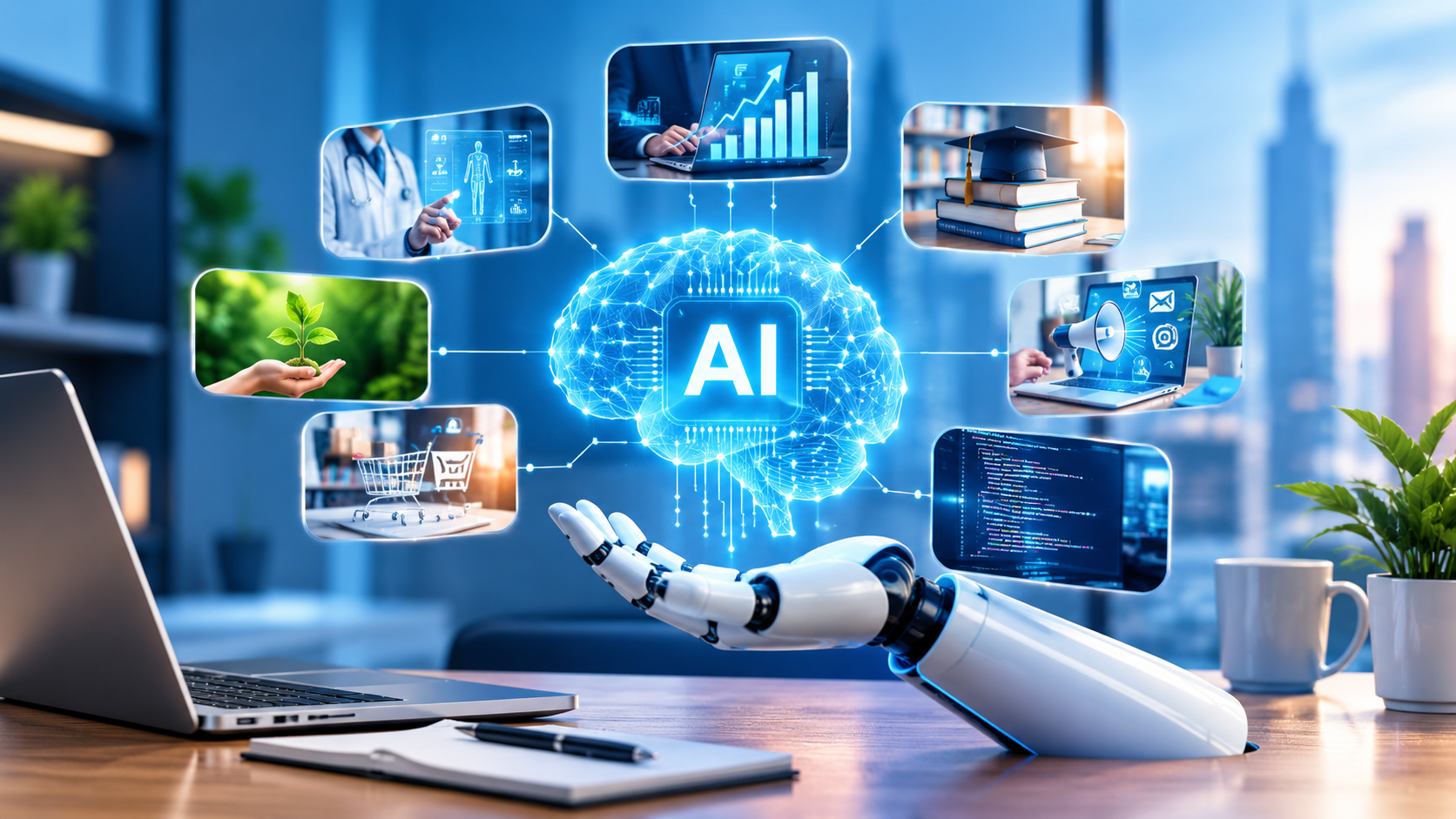
Today, AI is used in many industries, including healthcare, education, finance, marketing, customer service, and software development. Some applications help people complete routine tasks faster, while others assist professionals with analyzing complex information.
However, artificial intelligence is not perfect. AI systems can generate inaccurate information, reflect biases, and create privacy or security risks when used carelessly. Understanding both the capabilities and limitations of AI is essential for using it effectively.
In this comprehensive guide, you will learn what artificial intelligence means, how it works, the main types of AI, its real-world applications, the benefits and disadvantages, popular AI tools, and the trends shaping its future in 2026.
What Is Artificial Intelligence?
Artificial intelligence is a field of computer science focused on developing systems that can perform tasks associated with human intelligence. Depending on their design, these systems can process language, recognize images, identify patterns, generate content, make predictions, and recommend actions.
Traditional computer programs generally follow explicit instructions written by developers. Many AI systems, in contrast, use models trained on data to identify patterns and produce outputs for new inputs.
For example, an email service may use AI to identify spam messages. An online shopping platform may recommend products based on browsing activity. An AI writing assistant may generate a draft from a user’s instructions.
These examples demonstrate how artificial intelligence can support different tasks, but they do not mean that AI thinks or understands the world exactly as humans do.
The quality of an AI system’s output depends on factors such as its model, training data, instructions, available information, and operating environment.
What Does Intelligence Artificielle Mean?
Intelligence artificielle is the French translation of artificial intelligence. Both expressions refer to the same broad field of technology.
The abbreviation AI is commonly used in English-language discussions, while IA, short for intelligence artificielle, is commonly used in French.
For an English-speaking audience in the United States, artificial intelligence is the more natural primary keyword for this article. The French phrase remains relevant when explaining translations or discussing French-language AI resources.
How Does Artificial Intelligence Work?
Artificial intelligence works through different computational methods. The exact process depends on the type of system and the task it is designed to perform.
1. Data Collection and Preparation
Many AI systems use data to learn patterns or produce useful outputs. This data may include text, images, audio, numerical records, or other information.
For example, an image recognition model may be trained using labeled images, while a forecasting system may analyze historical numerical data.
Data quality matters. Inaccurate, incomplete, outdated, or unrepresentative information can affect a model’s performance.
2. Model Training
Machine learning models are trained using examples and optimization techniques that help them identify useful patterns.
During training, the model’s parameters are adjusted to improve its performance on a particular task.
Some AI applications use pretrained models, while others combine trained models with explicit rules, external databases, or additional software.
3. Input Processing
After development, an AI system receives an input such as a question, image, document, or dataset.
The system processes that information according to its design. For example, a language model processes text, while an image recognition system analyzes visual features.
4. Generating an Output
The system produces a result based on the input and its learned capabilities. This output may be a prediction, classification, recommendation, summary, or generated content.
For example, an AI assistant may prepare an email draft, summarize a document, or explain a technical concept.
5. Evaluation and Human Review
AI outputs should be evaluated to determine whether they are accurate, relevant, and suitable for the intended purpose.
For important tasks, human review helps identify errors, missing context, and potentially harmful recommendations.
AI can support decision-making, but it should not automatically be treated as an authoritative source of truth.
For further reading, visit the National Institute of Standards and Technology (NIST), which provides resources on artificial intelligence research, standards, and risk management.
What Are the Main Types of Artificial Intelligence?
Artificial intelligence can be classified according to its capabilities and the methods used to develop it. Understanding these distinctions makes it easier to evaluate different AI applications.
1. Narrow Artificial Intelligence
Narrow AI describes systems designed for specific tasks or a limited range of related activities. Most AI applications currently used in everyday life fall into this category.
Examples include:
- Email spam filters
- Voice assistants
- Image recognition software
- Product recommendation systems
- AI writing assistants
- Customer service chatbots
A narrow AI system may perform its intended task effectively without having the ability to perform unrelated tasks.
2. Machine Learning
Machine learning is a branch of artificial intelligence that enables systems to learn patterns from data and use those patterns to make predictions or classifications.
For example, a financial organization may use machine learning to identify unusual transaction patterns that deserve further investigation.
Machine learning is used in fraud detection, forecasting, recommendation systems, image recognition, and many other applications.
3. Deep Learning
Deep learning is a type of machine learning that uses multilayered artificial neural networks to identify complex patterns.
It supports many modern AI applications, including speech recognition, image analysis, language processing, and advanced content generation.
Deep learning models can be powerful, but they may require substantial computing resources and carefully designed training processes.
4. Generative Artificial Intelligence
Generative AI produces new content based on patterns learned during training. Depending on the system, it can generate text, images, audio, video, or computer code.
For example, a generative AI tool can help create an article outline, draft a presentation, develop image concepts, or explain a programming error.
Generative AI is useful for creative and productivity tasks, but its outputs may contain errors and should be reviewed before publication or professional use.
5. Predictive Artificial Intelligence
Predictive AI uses data and statistical or machine learning models to estimate likely outcomes.
Examples include:
- Forecasting product demand
- Estimating customer churn
- Identifying unusual transactions
- Predicting equipment maintenance needs
- Supporting inventory planning
Predictions are estimates, not guarantees. Their reliability depends on data quality, model performance, and whether future conditions resemble the information used to develop the model.
6. AI Agents
AI agents are systems designed to pursue defined goals by carrying out one or more steps. Depending on their design, they may use external tools, access approved information, and coordinate tasks across connected applications.
For example, an AI agent might research a topic, organize findings, prepare a summary, and request human approval before taking a further action.
Agent capabilities vary considerably. Permissions, safeguards, testing, and human oversight are important when agents interact with business systems.
Read our related guide: AI Agent Platforms: 7 Best Choices for 2026.
Important distinction: Machine learning and deep learning are technical approaches within AI. Generative and predictive AI describe different capabilities or applications, while narrow AI describes a category of system capability. These categories can overlap.
10 Real-World Applications of Artificial Intelligence
Artificial intelligence is used across many industries. Its practical value depends on the problem being solved, the quality of the system, and how people use its outputs.
1. Artificial Intelligence in Everyday Life
Many people interact with AI without actively searching for AI products.
Everyday examples include:
- Email spam filtering
- Voice assistants
- Navigation and traffic predictions
- Personalized content recommendations
- Predictive text
- Photo organization and image recognition
These applications can help people find information, organize digital activities, and interact with software more conveniently.
However, recommendations may reflect incomplete information or personalization choices. Users should understand that automated suggestions do not always represent the best or most objective option.
2. Artificial Intelligence in Business
Businesses use AI to organize information, analyze customer behavior, support market research, improve customer communication, and automate selected workflows.
For example, a small marketing agency may use AI-assisted research to identify potential customer segments and prepare initial outreach drafts. Its employees can then verify the information and personalize the communication.
Larger organizations may integrate AI into customer relationship management systems, reporting tools, and internal workflows.
Explore our guide to AI Business Development: 7 Powerful Strategies for Business Growth in 2026 for more information about AI-assisted business growth.
3. Artificial Intelligence in Healthcare
Healthcare organizations use AI for applications such as medical image analysis, research support, administrative processes, and certain clinical decision-support tasks.
For example, an AI system may help identify patterns in medical images that require further review by a qualified professional.
AI may also assist with organizing medical information and supporting research workflows.
Healthcare applications require careful evaluation of accuracy, privacy, safety, and performance across different patient populations. AI-generated recommendations should not replace appropriate professional judgment.
4. Artificial Intelligence in Education
AI-powered educational tools can help students understand difficult topics, create practice questions, summarize learning materials, and receive feedback on writing.
Teachers may use AI to brainstorm lesson activities, develop examples, or prepare alternative explanations for challenging concepts.
For example, a student studying mathematics can ask an AI assistant to explain a problem step by step, then solve similar questions independently.
Students should verify important information and follow their institution’s academic integrity policies.
5. Artificial Intelligence in Digital Marketing
Digital marketing teams use AI to support keyword research, brainstorm content ideas, analyze campaign performance, summarize customer feedback, and draft marketing materials.
For example, an SEO professional may use an AI tool to organize keyword ideas into topic clusters or generate an initial outline for an informational article.
However, AI-generated content should be reviewed for factual accuracy, originality, search intent, and genuine usefulness.
Publishing large amounts of unreviewed content simply to attract search traffic can undermine content quality. The goal should be to help readers answer their questions effectively.
Explore our related guide to AI Writing Tools for more information about AI-assisted writing.
6. Artificial Intelligence in Customer Service
AI-powered chatbots and virtual assistants can answer routine questions, provide basic instructions, organize support requests, and direct customers to relevant resources.
Some systems can also assist with appointment scheduling, reminders, and follow-up communication.
For example, a service business may use an AI appointment assistant to collect basic inquiry details and offer available meeting times.
Read our guide to AI Appointment Setter: 7 Best Tools for 2026 to explore this application.
Businesses should provide a clear route to human support when an issue is complex, sensitive, or outside the AI system’s capabilities.
7. Artificial Intelligence in Finance
Financial institutions use AI for applications such as fraud detection, transaction monitoring, customer service, and risk analysis.
AI systems may identify unusual activity by examining patterns across transactions. These alerts can help investigators prioritize cases for further review.
Financial AI must be evaluated carefully because incorrect predictions can affect customers, business decisions, and risk assessments.
Users should also understand that AI-generated financial explanations are not a substitute for qualified advice when a decision requires professional expertise.
8. Artificial Intelligence in Retail and E-Commerce
Retailers use AI to support product recommendations, demand forecasting, inventory planning, customer service, and analysis of customer feedback.
For example, an online store may recommend related products based on a shopper’s browsing activity or previous purchases.
Demand forecasting tools can also help retailers estimate which products may require replenishment.
The effectiveness of these applications depends on data quality, changing customer behavior, and appropriate business controls.
9. Artificial Intelligence in Software Development
AI coding assistants can explain programming concepts, suggest code, generate initial drafts, and help developers investigate errors.
They can also assist with documentation and repetitive development tasks.
However, generated code may contain security vulnerabilities, incorrect assumptions, or compatibility problems. Developers should test the output, review dependencies, and verify that the code meets project requirements before using it.
AI is best treated as a development assistant rather than an automatic replacement for software engineering expertise.
10. Artificial Intelligence in Research and Content Creation
Researchers, analysts, writers, and content teams can use AI to brainstorm ideas, organize notes, summarize documents, and develop initial drafts.
For example, a researcher may use AI to create a preliminary outline of a topic before consulting original studies and authoritative publications.
A content team may use AI to prepare alternative headlines or organize frequently asked questions.
These applications can improve workflow efficiency, but source verification remains essential. AI-generated citations and factual claims should never be accepted without checking their accuracy.
For related resources, explore Drovenio AI Tools 2025: Features, Review & Best Alternatives.
What Are the Main Benefits of Artificial Intelligence?
Artificial intelligence can offer several practical advantages when implemented for suitable tasks.
1. Improved Productivity
AI can help with repetitive activities such as categorizing information, preparing summaries, drafting routine communications, and organizing documents.
This may allow people to devote more time to work requiring creativity, expertise, and communication.
2. Faster Information Analysis
AI systems can process large datasets and identify patterns that may be difficult to recognize manually.
For example, an organization may use analytical tools to identify changes in customer behavior or unusual transaction patterns.
The findings still need to be interpreted in context.
3. More Consistent Workflows
Well-designed automation can help organizations follow repeatable procedures, standardize routine tasks, and reduce some forms of manual error.
However, poorly configured automation can also repeat mistakes at scale, making testing and monitoring important.
4. Personalized Experiences
AI can help digital services tailor recommendations, search results, and communications to relevant user preferences.
Personalization can make services more useful, provided that the data is handled responsibly and users have appropriate privacy protections.
5. Creative Assistance
Generative AI can support brainstorming, outlining, drafting, and exploring different approaches to a problem.
For example, a marketing team can ask an AI assistant to suggest several campaign concepts before developing and testing the most promising ideas.
6. Decision Support
AI-powered analytics can help users compare information, identify trends, and evaluate potential options.
These systems can inform decisions, but they should not automatically replace professional judgment, especially when decisions have significant financial, legal, medical, or personal consequences.
7. Scalable Digital Services
Some AI applications can help organizations handle larger volumes of routine requests without increasing manual effort at the same rate.
Nevertheless, scaling an AI system requires adequate infrastructure, monitoring, support processes, and safeguards.
The bottom line: AI can improve productivity and support decision-making, but results depend on the task, implementation, data quality, cost, and human oversight.
What Are the Disadvantages and Risks of Artificial Intelligence?
Despite its advantages, AI introduces limitations that users and organizations should understand.
1. Inaccurate Information
AI systems can generate incorrect facts, incomplete explanations, misleading summaries, or fabricated details.
How to manage this risk: Verify important claims using reliable sources and consult qualified professionals when necessary.
2. Privacy and Data Security
Uploading confidential business records, personal information, or customer data to an unsuitable AI service may create privacy and security risks.
How to manage this risk: Review the provider’s data policies, follow applicable laws, and avoid sharing sensitive information without proper authorization.
3. Bias and Unfair Outcomes
AI systems may reproduce biases present in training data, historical records, or system design.
How to manage this risk: Evaluate systems for unfair outcomes and monitor performance across relevant groups, particularly when AI influences decisions affecting people.
4. Employment and Skills Changes
AI can automate some tasks and change the responsibilities associated with certain occupations.
The impact varies by industry, role, and implementation. Developing relevant technical, analytical, and interpersonal skills can help workers adapt to changing requirements.
5. Implementation Costs
Businesses may face subscription fees, integration costs, employee training requirements, and ongoing maintenance expenses.
How to manage this risk: Begin with a clearly defined use case and compare measurable benefits with the full cost of implementation.
6. Overreliance on Automation
AI systems may fail to recognize unusual circumstances, understand important context, or respond appropriately to sensitive situations.
How to manage this risk: Define which tasks AI may perform independently and which require human approval or intervention.
7. Security and Misuse
AI can be used in harmful ways, including generating deceptive content or supporting certain forms of cyber abuse.
Organizations should apply appropriate access controls, security testing, monitoring, and incident-response procedures.
For additional guidance, consult the NIST AI Risk Management Framework, which provides resources for identifying and managing AI-related risks.
Popular Artificial Intelligence Tools in 2026
AI tools serve different purposes, from writing and research to customer management and software development. The right choice depends on the task you need to complete.
1. ChatGPT
ChatGPT can help users brainstorm, explain concepts, summarize information, draft content, and work through certain analytical tasks.
It can be useful for students, writers, professionals, and business owners who need a general-purpose AI assistant.
Users should verify important facts and review generated content before relying on it.
2. Google Gemini
Google Gemini provides AI assistance for tasks such as answering questions, generating content, and working with supported Google services and other features available through the product.
Its capabilities and integrations depend on the specific version, subscription, and account configuration.
3. Microsoft Copilot
Microsoft Copilot offers AI assistance across supported Microsoft products and other experiences. Depending on the version, it can help users draft content, summarize information, and work with documents.
Check the available features and data-handling terms for the specific version you plan to use.
4. Grammarly
Grammarly provides writing assistance, including grammar suggestions, clarity improvements, and features for adjusting tone and style.
It can help users review drafts, but writers should still check the meaning, accuracy, and appropriateness of suggested changes.
5. HubSpot
HubSpot provides customer relationship management and marketing, sales, and service tools, with AI features available across supported products and plans.
Businesses can evaluate it when they need to organize customer interactions and manage sales or marketing workflows.
6. Salesforce
Salesforce offers CRM software and AI-enabled features for supported sales, service, marketing, and business processes.
Its suitability depends on organizational requirements, integrations, costs, and the specific product configuration.
How to Choose the Right AI Tool
Before selecting a tool, consider the following questions:
- What specific problem do you want to solve?
- Does the tool provide the features you need?
- Can it integrate with your existing software?
- What are its subscription and usage costs?
- How does it handle your data?
- Can you verify and control its outputs?
- Does it provide appropriate support and security features?
Avoid subscribing to several overlapping tools before establishing what your workflow actually requires. Test one suitable solution and evaluate its results before expanding.
How to Start Using Artificial Intelligence as a Beginner
You do not need to be a programmer to start learning about AI. Many accessible tools can help beginners explore its capabilities.
Step 1: Identify Your Goal
Decide what you want AI to help you accomplish. Examples include learning a subject, improving writing, organizing information, or automating a repetitive task.
Step 2: Choose an Appropriate Tool
Select a tool designed for your intended task. Review its features, limitations, privacy practices, and cost before using it.
Step 3: Write Clear Instructions
Explain what you want the system to do, provide relevant context, and specify the output format.
For example, instead of asking, “Explain AI,” you could ask, “Explain machine learning in simple English, provide two practical examples, and list three limitations.”
Step 4: Review the Output
Check facts, calculations, recommendations, and important claims. Ask follow-up questions when the explanation is unclear, but remember that additional AI responses may also contain errors.
Step 5: Protect Your Information
Do not upload confidential records or sensitive personal information unless the service and your authorization permit it.
Step 6: Measure the Results
Consider whether the tool saves time, improves accuracy, or helps you complete the task more effectively.
Starting with a small, low-risk task makes it easier to understand both the benefits and the limitations of AI.
How Businesses Can Implement AI Successfully
Businesses should adopt AI to solve defined problems rather than introducing technology simply because it is popular.
1. Set a Measurable Objective
Choose a clear goal, such as reducing research time, improving response times, or organizing customer records more efficiently.
2. Review Existing Processes
Identify repetitive work, delays, data-quality problems, and tasks that require unnecessary manual effort.
3. Select a Suitable Solution
Compare tools based on functionality, integration, cost, security, and ease of use.
4. Run a Small Pilot
Test the solution with a limited workflow or team. Record its performance before and after implementation.
5. Train Employees
Teach employees how to use the system, verify its outputs, protect confidential information, and identify situations requiring human intervention.
6. Monitor Performance
Measure relevant indicators, including accuracy, time saved, costs, customer satisfaction, and error rates.
Expand the implementation only when the evidence indicates that the tool provides meaningful value.
What Is the Future of Artificial Intelligence?
Artificial intelligence continues to develop across language models, data analysis, automation, robotics, and multimodal systems.
Several trends are worth watching in 2026 and beyond.
More Capable AI Assistants
AI assistants may increasingly support connected tasks involving research, writing, planning, and analysis.
Their practical usefulness will depend on reliability, integration, and the ability to handle tasks within appropriate boundaries.
AI Agents and Workflow Automation
AI agents may take on more multistep workflows when connected to suitable tools and granted appropriate permissions.
Organizations will need to manage access controls, testing, monitoring, and human approval for sensitive actions.
Multimodal Artificial Intelligence
Multimodal systems can process or combine different forms of information, including text, images, audio, and video.
These capabilities may support more flexible interfaces and new applications across education, business, and digital services.
More Specialized AI Applications
Organizations may increasingly use AI systems designed for particular industries, datasets, and professional workflows.
Specialization can improve relevance, but performance still requires evaluation in the intended environment.
Greater Focus on AI Governance
Privacy, transparency, safety, accountability, and reliability will remain important as AI becomes more integrated into digital systems.
Businesses and public institutions will need appropriate policies and controls to manage the risks associated with different applications.
The future of AI will not be determined by technology alone. Costs, regulation, public trust, infrastructure, and demonstrated usefulness will influence how widely different systems are adopted.
Frequently Asked Questions About Artificial Intelligence
1. What is artificial intelligence in simple words?
Artificial intelligence is technology that enables computer systems to perform tasks such as recognizing patterns, processing language, making predictions, and generating content. Different AI systems are designed for different tasks and have different limitations.
2. What does intelligence artificielle mean?
Intelligence artificielle is the French translation of artificial intelligence. Both expressions refer to the same broad field of technology. English-speaking users generally use the term AI or artificial intelligence.
3. What are the main types of artificial intelligence?
Commonly discussed categories include narrow AI, machine learning, deep learning, generative AI, and predictive AI. These categories describe different capabilities and technical approaches, so they are not all mutually exclusive.
4. What are the most common applications of AI?
AI is used in virtual assistants, recommendation systems, spam filters, healthcare research, education, marketing, customer service, fraud detection, software development, and business analytics.
5. What is the difference between artificial intelligence and machine learning?
Artificial intelligence is the broader field of creating systems that perform tasks associated with human intelligence. Machine learning is a branch of AI that uses data to learn patterns and support predictions or classifications.
6. Is generative AI the same as artificial intelligence?
No. Generative AI is a category of AI that creates content such as text, images, audio, video, or code. Artificial intelligence also includes systems that classify information, make predictions, detect patterns, or provide recommendations.
7. Can artificial intelligence make mistakes?
Yes. AI systems can generate inaccurate facts, misleading explanations, biased outputs, or unsuitable recommendations. Users should verify important information and seek appropriate professional advice for high-impact decisions.
8. Is artificial intelligence useful for small businesses?
Yes. Small businesses can use AI to assist with research, content drafting, customer support, lead organization, and selected administrative tasks. They should choose tools based on their needs, budget, privacy requirements, and measurable results.
9. Will artificial intelligence replace human jobs?
AI can automate certain tasks and change job responsibilities, but its effects vary across occupations and industries. Human judgment, communication, creativity, accountability, and specialist knowledge remain important in many roles.
10. How can beginners learn artificial intelligence?
Beginners can start by learning basic AI concepts, experimenting with accessible tools, practicing clear instructions, and verifying generated information. Learning about data quality, privacy, and responsible AI use is also valuable.
11. Is artificial intelligence safe to use?
AI can be useful when applied appropriately, but its safety depends on the system, task, data, and operating environment. Users should protect sensitive information, verify outputs, and apply additional safeguards for high-impact applications.
12. What is the future of artificial intelligence?
Future developments may include more capable AI assistants, agent-based automation, multimodal systems, and specialized applications. Their adoption will depend on technical performance, costs, regulation, security, and practical value.
Conclusion
Artificial intelligence is transforming how people and organizations process information, generate content, analyze patterns, and complete everyday tasks.
Its applications span business, healthcare, education, marketing, finance, customer service, and software development. When used appropriately, AI can improve productivity, support analysis, and help people explore new approaches to complex problems.
However, AI also has important limitations. Inaccurate outputs, privacy concerns, bias, security risks, and implementation costs must be considered before relying on these systems.
The best approach is to begin with a specific problem, select an appropriate tool, test its performance, and verify the results. Businesses should establish measurable objectives and keep people involved in decisions that require judgment and accountability.
As AI technology continues to evolve, understanding its capabilities and limitations will help individuals and organizations make more informed decisions.
Ultimately, artificial intelligence is most useful when it complements human expertise, supports real needs, and is implemented responsibly.