

10 Essential Cybersecurity Best Practices for 2026
Cybersecurity Best Practices Cyber Threat Prevention, Cybersecurity 2026, Cybersecurity Best Practices, Cybersecurity Tips, Data Protection, Network Security, Online Security, Password Security, Phishing Prevention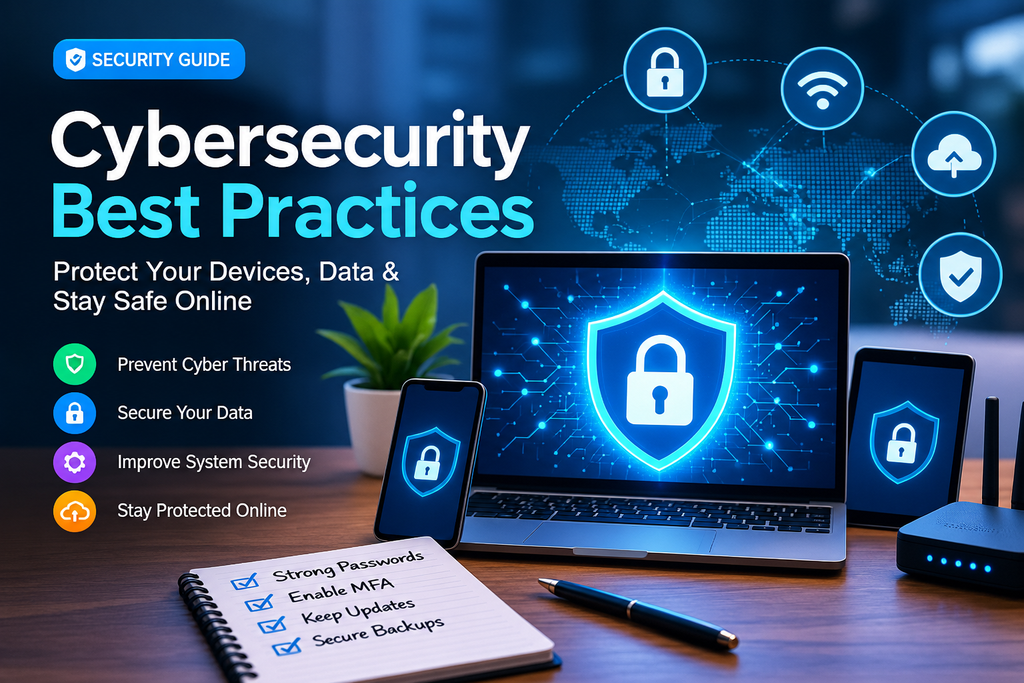
Cybersecurity best practices are essential for protecting personal information, business systems, and digital networks from cyber threats in 2026. As organizations increasingly rely on cloud computing, online payments, remote work, and connected devices, maintaining strong cybersecurity has become a critical business responsibility.
Cybercriminals use phishing, ransomware, malware, and stolen credentials to compromise sensitive information. A successful attack can expose confidential records, interrupt operations, and cause financial losses.
Fortunately, following proven cybersecurity best practices can help individuals and businesses reduce vulnerabilities, prevent common attacks, and respond more effectively to security incidents.
In this guide, Tech Crown explains ten essential cybersecurity measures, common digital threats, practical business security strategies, and the steps organizations should take to strengthen their defenses.
What Is Cybersecurity?
Cybersecurity is the practice of protecting computers, networks, applications, devices, and digital information against unauthorized access, malicious activity, and disruption.
It combines security technologies, organizational policies, employee awareness, and risk management procedures.
Effective cybersecurity follows three fundamental principles known as the CIA triad:
- Confidentiality: Ensuring sensitive information is accessible only to authorized individuals.
- Integrity: Protecting information against unauthorized changes or corruption.
- Availability: Ensuring systems and information remain accessible when required.
For example, online banking platforms use authentication and encryption to protect customer accounts. Businesses use similar safeguards to secure financial records, customer information, and internal systems.
Understanding these principles provides a foundation for implementing effective cybersecurity best practices.
Why Are Cybersecurity Best Practices Important in 2026?
Businesses depend on interconnected technologies to manage essential operations. While these technologies improve productivity, they also create potential security risks.
Attackers may exploit weak passwords, outdated applications, insecure configurations, or employee mistakes.
Implementing cybersecurity best practices offers several important benefits.
Protecting Sensitive Information
Customer records, payment details, employee information, and confidential documents require appropriate security controls.
Encryption, secure authentication, and access restrictions help prevent unauthorized disclosure.
Reducing Financial Losses
Cyber incidents can result in fraudulent transactions, recovery expenses, operational downtime, and other financial consequences.
Preventive security controls can reduce the likelihood and impact of these incidents.
For more detailed financial protection advice, read Tech Crown’s guide to 10 Essential Ways to Protect Financial Data in 2026.
Maintaining Business Continuity
Ransomware and other attacks can disrupt websites, payment processing, communication systems, and business applications.
Secure backups and incident response planning help organizations recover essential services.
Building Customer Trust
Customers expect businesses to protect personal information responsibly.
Organizations that maintain appropriate cybersecurity controls can strengthen customer confidence and reduce reputational risks.
Common Cybersecurity Threats You Should Know
Understanding common cyber threats is an important part of applying cybersecurity best practices.
Phishing Attacks
Phishing involves fraudulent emails, text messages, or websites designed to trick users into revealing confidential information.
Attackers may impersonate banks, employers, or legitimate service providers.
Ransomware
Ransomware can encrypt files, disrupt systems, and demand payment for restoring access.
Some attackers also steal confidential information and threaten to disclose it.
Malware
Malware includes malicious programs such as trojans, spyware, and worms.
These programs may steal information, compromise devices, or disrupt operations.
Credential Theft
Cybercriminals may obtain passwords through phishing, malicious software, or previous data breaches.
Password reuse increases the risk of multiple accounts being compromised.
Denial-of-Service Attacks
Denial-of-service attacks attempt to make websites, applications, or networks unavailable by overwhelming their resources.
Recognizing these threats helps businesses prioritize appropriate security controls.
10 Essential Cybersecurity Best Practices for 2026
The following cybersecurity best practices provide practical protection for individuals, employees, and organizations.
1. Create Strong and Unique Passwords
Passwords remain an important defense against unauthorized account access.
Use long, unique passwords for banking, email, business applications, and other sensitive accounts.
Avoid predictable passwords and never reuse important credentials across multiple services.
A reputable password manager can help generate and securely store complex passwords.
The Cybersecurity and Infrastructure Security Agency (CISA) recommends strong passwords, multifactor authentication, phishing awareness, and software updates as foundational online safety measures.
Practical tip: Prioritize unique passwords for email accounts because compromised email access may allow attackers to reset passwords for other services.
2. Enable Multifactor Authentication
Multifactor authentication (MFA) requires additional verification beyond a password.
Even when attackers obtain login credentials, MFA can make unauthorized access more difficult.
Enable MFA for email, banking, cloud applications, and administrative accounts.
Where available, consider phishing-resistant authentication methods such as passkeys or security keys.
Enabling MFA is one of the most valuable cybersecurity best practices for protecting sensitive accounts.
Practical tip: Never share authentication codes with someone who contacts you unexpectedly.
3. Keep Software and Devices Updated
Outdated software may contain vulnerabilities that attackers can exploit.
Enable automatic security updates where practical and install important patches promptly.
Businesses should regularly review operating systems, browsers, applications, and connected equipment.
Unsupported software should be replaced or protected through appropriate risk-reduction measures.
Practical tip: Maintain an inventory of important devices and applications so outdated systems can be identified.
4. Recognize and Report Phishing Attempts
Phishing attacks often rely on urgency, deception, and impersonation.
Be cautious of unexpected messages requesting passwords, payment information, or confidential documents.
Verify suspicious requests through official communication channels rather than unfamiliar links.
Employees should report suspicious messages to their organization’s designated security contact.
Practical tip: If an email requests an urgent payment or account change, verify the request using a previously confirmed phone number.
5. Maintain Secure Data Backups
Regular backups help protect important information against ransomware, accidental deletion, and hardware failures.
Maintain protected backup copies and restrict unauthorized access.
For critical information, consider offline or appropriately isolated backups.
Test restoration procedures regularly to confirm that important systems and records can be recovered.
Reliable backups are essential cybersecurity best practices for maintaining business continuity.
Practical tip: Include recovery testing in your organization’s regular security maintenance schedule.
6. Use Firewalls and Endpoint Protection
Firewalls help control network traffic according to defined security rules.
Endpoint protection software can detect malicious programs and suspicious activity on computers and connected devices.
Organizations should combine these technologies with secure configurations, updates, and monitoring.
No single security product can eliminate every cyber risk.
Practical tip: Review endpoint security alerts regularly and investigate important warnings rather than ignoring them.
7. Apply the Principle of Least Privilege
The principle of least privilege means giving users only the permissions necessary for their responsibilities.
Restrict administrative access and review permissions regularly.
Remove unnecessary access when employees change roles or leave an organization.
This approach helps reduce the potential damage caused by compromised accounts.
Practical tip: Avoid using administrator accounts for routine activities such as email and general web browsing.
8. Encrypt Sensitive Information
Encryption helps protect confidential information during transmission and storage.
Use HTTPS for secure web communications and appropriate encryption for devices, databases, and backups.
Businesses handling customer records or financial information should carefully manage encryption keys and access permissions.
Encryption supports confidentiality but does not replace strong authentication or access management.
Practical tip: Enable full-disk encryption on supported business laptops that store sensitive information.
9. Provide Cybersecurity Awareness Training
Employees play an important role in organizational security.
Training should cover phishing, password management, suspicious attachments, safe browsing, and incident reporting.
Organizations should refresh training periodically and encourage employees to report potential threats promptly.
An informed workforce supports stronger cybersecurity best practices across the organization.
Practical tip: Use realistic phishing-awareness exercises and provide constructive feedback to employees.
10. Develop an Incident Response Plan
An incident response plan defines how an organization identifies, contains, investigates, and recovers from cybersecurity incidents.
Assign responsibilities, establish communication procedures, and document recovery priorities.
Test the plan through exercises and update it when systems or business requirements change.
Effective incident response can reduce disruption and support faster recovery.
Practical tip: Maintain an accessible list of important incident contacts and recovery responsibilities.
Cybersecurity Best Practices for Small Businesses
Small businesses may have limited security resources, but they still manage valuable information and depend on reliable digital services.
A practical cybersecurity strategy should begin with identifying important systems, reviewing access permissions, enabling MFA, and maintaining secure backups.
Businesses should also document security responsibilities and provide basic employee awareness training.
The NIST Cybersecurity Framework 2.0 provides a structured approach to managing cybersecurity risks.
Its six core functions are:
- Govern: Establish security policies, responsibilities, and risk management expectations.
- Identify: Understand important assets, systems, and cybersecurity risks.
- Protect: Implement safeguards against threats.
- Detect: Monitor systems for suspicious activity.
- Respond: Contain and manage cybersecurity incidents.
- Recover: Restore affected operations and improve resilience.
These functions help organizations evaluate existing controls and prioritize improvements.
Small businesses can also consult the NIST Small Business Quick Start Guide.
How Artificial Intelligence Affects Cybersecurity in 2026
Artificial intelligence is increasingly used to support cybersecurity monitoring, threat detection, and incident investigation.
AI-assisted tools can analyze security data, identify unusual patterns, and help analysts prioritize suspicious activity.
For example, an AI security system may flag unexpected login behavior, abnormal file access, or unusual network communication.
However, AI tools can generate false alerts or overlook genuine threats. Cybercriminals may also misuse generative AI to create convincing phishing messages.
Organizations should combine AI-assisted tools with human oversight, appropriate testing, and established security controls.
To understand these technologies in greater detail, explore Tech Crown’s guide to Artificial Intelligence in Cybersecurity: 7 Powerful Benefits.
Cybersecurity Best Practices for Financial Data Protection
Financial information requires additional attention because compromised accounts and payment credentials can enable fraud.
Individuals and businesses should use strong authentication, secure devices, transaction monitoring, and appropriate encryption.
Avoid sharing banking credentials through email or unexpected messages.
Businesses should also verify changes to supplier payment instructions and restrict access to financial records.
For a complete financial security checklist, see Tech Crown’s financial data protection guide.
Cybersecurity for Government and Public Sector Organizations
Government agencies and public service providers may manage sensitive citizen information and essential digital services.
These organizations need appropriate access controls, monitoring, employee training, secure backups, and incident response procedures.
Cybersecurity programs should reflect operational risks and applicable legal requirements.
For additional guidance, read Tech Crown’s article on Public Sector Cybersecurity.
How to Build a Long-Term Cybersecurity Strategy
Successful cybersecurity requires ongoing assessment rather than one-time improvements.
Start by identifying critical information, connected devices, and essential business systems.
Review existing security controls and prioritize vulnerabilities according to their potential impact.
Implement protective measures, monitor suspicious activity, and regularly test recovery procedures.
Organizations should also review third-party service providers and maintain clear security responsibilities.
Companies considering advanced threat monitoring can explore Tech Crown’s guide to AI-Driven Cybersecurity for Indian Companies.
Following cybersecurity best practices consistently helps organizations create a more resilient digital environment.
Frequently Asked Questions About Cybersecurity Best Practices
What are the most important cybersecurity best practices?
The most important cybersecurity best practices include using strong passwords, enabling multifactor authentication, updating software, recognizing phishing attempts, maintaining secure backups, and restricting unnecessary access. Businesses should also train employees and develop incident response procedures.
Why is cybersecurity important for small businesses?
Cybersecurity helps small businesses protect customer information, financial records, and essential operations. Appropriate security controls can reduce the risk of fraud, operational disruption, and data breaches while supporting customer confidence.
How often should businesses update cybersecurity measures?
Businesses should review security measures regularly and whenever important changes occur. New vulnerabilities, software updates, security incidents, and changes in business operations may require additional assessments or improvements.
What is the difference between cybersecurity and information security?
Cybersecurity focuses primarily on protecting digital systems, networks, devices, and information from cyber threats. Information security is broader and includes protecting information in both physical and digital forms.
Can cybersecurity best practices prevent every cyberattack?
No cybersecurity strategy can guarantee complete protection. However, combining preventive controls, monitoring, employee awareness, and incident response planning can reduce risks and improve recovery capabilities.
How does AI improve cybersecurity?
AI-assisted security tools can help identify suspicious activity, correlate alerts, and support incident investigations. However, their effectiveness depends on data quality, configuration, testing, and human oversight.
What should businesses do after a cyberattack?
Businesses should follow their incident response procedures, contain affected systems, preserve relevant evidence, investigate the incident, and restore operations securely. They should also assess applicable notification and reporting requirements.
Conclusion
Cybersecurity best practices are essential for protecting personal information, business networks, and digital systems against evolving threats in 2026.
Strong passwords, multifactor authentication, software updates, secure backups, employee awareness, and incident response planning provide a practical foundation for digital protection.
Organizations should also use recognized cybersecurity frameworks to evaluate risks and improve security strategies.
By following cybersecurity best practices consistently, individuals and businesses can reduce vulnerabilities, strengthen digital resilience, and build a safer online environment.